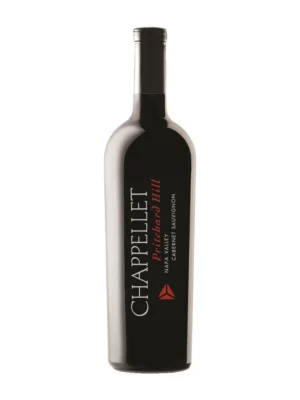

Chappellet is recognized as one of the great Napa Valley wineries, and one of the few which remains family owned. Today, the second generation is committed to continuing the vision of their parents, Donn and Molly Chappellet. Together, the siblings are dedicated to maintaining sustainable farming techniques, a relentless focus on wine quality, respect for Pritchard Hill’s natural beauty and the preservation of family ownership for generations to come.
The most sought-after wine in the portfolio, this limited-production Cabernet Sauvignon represents the pinnacle of Chappellet winemaking and embodies the elegant power and complexity of Pritchard Hill winegrowing. Like the great Bordeaux wines that first inspired Donn Chappellet, this wine is crafted by blending Cabernet Sauvignon with other classic Bordeaux varietals. The wine was aged for 22 months in 100 percent new French oak. Grown on rocky, mountainside vineyard, these Cabernets have consistently displayed an ability to age for several decades.
“I inherited Château Cantelaudette in 1984, I was thirty years old and married in the same year. The property was not really a wedding gift: the house and vines had been abandoned and there was no winery. However, my wife, when she saw the old château, thought that it should be our home. Starting from scratch, we refurbished it to our taste, replanted the vines according to expert recommendations, and built an operational winery to produce a wine under the Cantelaudette label. Without my wife, Laurence, I never would have had the courage to undertake this adventure. I make wines for her and which reflect her… refined, elegant, balanced, rounded, and with a certain complexity.” – Jean-Michel Chatelier, owner and manager of Château Cantelaudette.
For more info, visit Château Cantelaudettewebsite.
“I inherited Château Cantelaudette in 1984, I was thirty years old and married in the same year. The property was not really a wedding gift: the house and vines had been abandoned and there was no winery. However, my wife, when she saw the old château, thought that it should be our home. Starting from scratch, we refurbished it to our taste, replanted the vines according to expert recommendations, and built an operational winery to produce a wine under the Cantelaudette label. Without my wife, Laurence, I never would have had the courage to undertake this adventure. I make wines for her and which reflect her… refined, elegant, balanced, rounded, and with a certain complexity.” – Jean-Michel Chatelier, owner and manager of Château Cantelaudette.
For more info, visit Château Cantelaudettewebsite.
“I inherited Château Cantelaudette in 1984, I was thirty years old and married in the same year. The property was not really a wedding gift: the house and vines had been abandoned and there was no winery. However, my wife, when she saw the old château, thought that it should be our home. Starting from scratch, we refurbished it to our taste, replanted the vines according to expert recommendations, and built an operational winery to produce a wine under the Cantelaudette label. Without my wife, Laurence, I never would have had the courage to undertake this adventure. I make wines for her and which reflect her… refined, elegant, balanced, rounded, and with a certain complexity.” – Jean-Michel Chatelier, owner and manager of Château Cantelaudette.
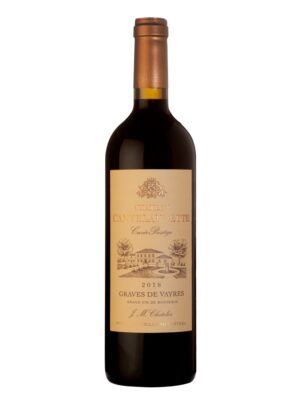
Grande Cuvée is a red wine produced in the Bordeaux region of France by Château Cantelaudette. This 2018 vintage comes from the Graves-de-Vayres appellation.
Certified Sustainable HVE & Vigneron Independant
For more info, visit Château Cantelaudettewebsite.
Located in the southern part of the Bordeaux Medoc peninsula, Château Cantemerle, designated a great growth in the famous 1855 classification, thanks to its unique terroir, produces complex well-balanced and refined wines.
The wine’s structure displays reserve and complexity, with a welltempered richness and great length. It represents a perfect model of elegance, balance, and the fine flavors typical of Cantemerle’s greatest wines.
Family owned since 1810, the Château Cap Léon Veyrin originates from the meeting of Château Cap Léon and the Veyrin estate. Cape comes from the word “head”. In fact, the vineyards of Cap Léon are located on the highest points of Listrac-Médoc, favoring natural drainage and ideal sunshine. Nathalie and Julien Meyre, are the 6th generation of the family running this property, perpetuate the tradition: predominance of Merlot, collage with egg white, aging of 12 months in barrels, manual harvesting for young parcels and for old vines, while bringing their dynamism to this renowned Cru Bourgeois Supérieur du Médoc.
For more info, visit Château Cap Léon Veyrinwebsite.
VARIETALS
60% Merlot, 35% Cabernet Sauvignon, 5% Petit Verdot
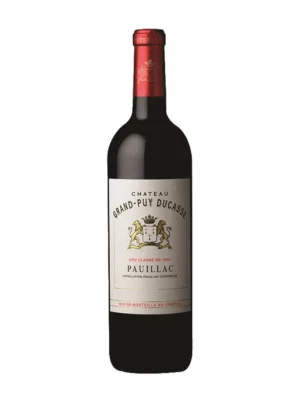
Three large plots in the best parts of Pauillac form the vineyard of this classified growth, an unusual configuration and a direct inheritance from the estate’s founder, Pierre Ducasse, an eminent lawyer. In the 18th century he gave a single name to a fine vineyard holding, which was put together through inheritance and purchases. When he died in 1797, his son, Pierre, inherited a 60-hectare exploitation, named Ducasse-Grand-Puy-Artigues-Arnaud, of which two third were planted with vines. The estate was classified in 1855, under the name of Artigues Arnaud.
Thanks to impeccable harvesting and tailor-made winemaking, Cabernet Sauvignon and Merlot produced a wine renowned for its aromatic complexity, glorious structure and ageing capacity, all true to the classic Pauillac style.
For more info, visit Château Grand-Puy Ducassewebsite.
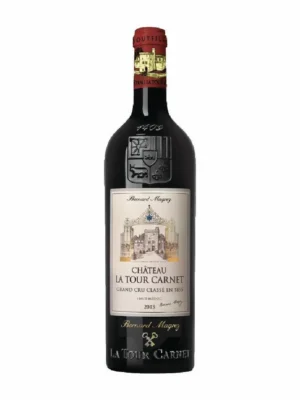
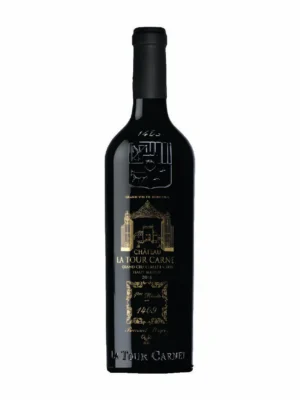
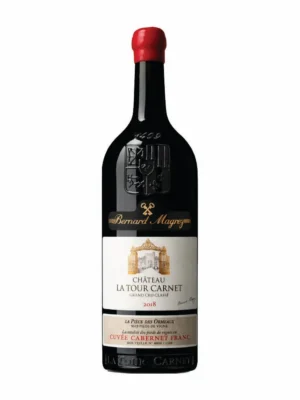
The history of La Tour Carnet merges with the history of France. Bearing the name of the squire who infallibly helped his Lord to resist French royalty at the end of the Hundred Years War, Château La Tour Carnet played a major role in the revolution of the Médoc vineyards and the quality of its wine, rewarded by the entry in the classification of Grands Crus Classés of 1855. The diversity of its terroir and the constant search for perfection make this Haut-Médoc an exceptional wine.
Since purchasing the estate in 2000, Bernard Magrez has returned the estate’s Château, cellars and 311 hectares to their glory days, marrying cutting-edge technology with traditional savoir-faire.
From the 17th century to the present day, ten generations of owners have followed one another and have left their mark on the history of Château Lascombes. A destiny marked by colorful characters who all worked for the excellence of Château Lascombes wines.
An alliance of power and elegance, smoothness and tannic richness, Château Lascombes is a complex wine. Young, its deep robe is still impressive. The palate combines finesse and softness with a grain of very noble tannins. Over the years, you have to rediscover Château Lascombes to fully appreciate its aromatic complexity and see its structure evolve, becoming more and more suave.
Depth, complexity and graceful power characterise this vintage, which reveals all its qualities after long ageing in the bottle. Predominantly Cabernet Sauvignon, it represents the Médoc’s winemaking tradition and embodies the great classicism of Margaux.
Château Pichon-Longueville is one of the most important wineries in the Bordeaux wine region. Since 1940 the company has considerably increased the vineyard property, passing from 40 to 100 hectares. Since 2021 it has been certified biodynamic. The terroir of is gravelly, characterized by a clayey and calcareous soil.
Château Pichon-Longueville Comtesse de Lalande is produced from grapes belonging to the famous cru of Paillac.
For more info, visit Château Pichon-Longueville Comtesse de Lalande website.
The Château Quinault l’Enclos property is located on the right bank of Bordeaux in the Saint-Émilion appellation. Belonging to the famous Château Cheval Blanc, the first classified A growth of Saint-Émilion, the wines of Château Quinault l’Enclos benefit from the same care as those of Château Cheval Blanc.
A vintage of challenges marked by strong climatic contrasts, 2018 will remain a great year in the memories of the property. The heavy rainfall at the start of the year will have generated significant mildew pressure. The precision and constant attention paid by the property’s technical teams made it possible to save Château Quinault L’Enclos from mildew. The beautiful summer which set in in July with an ideal September favored perfect ripening with berries with good concentration.
VARIETALS
72% Merlot, 14% Cabernet Sauvignon, 14% Cabernet Franc
Clos de l’Oratoire, located on Saint-Emilion’s northeast slope, has 13 hectares of vines. The terroir of Fronsac molasse, consisting of a layer of sandy soil and a clay subsoil, is ideally suited to Merlot (80% of the vines).
Clos de l’Oratoire is round, smooth, and very seductive. It has a beautiful deep crimson colour and powerful fruity aromas. Merlot provides roundness and opulence, whereas Cabernet Franc contributes power, aromatic complexity, and a long aftertaste. Although Clos de l’Oratoire can be enjoyed seven years after the vintage, it is, above all, a wine with fine ageing potential.
Disznókö is one of the most famous producers of sweet Tokaji in the world.
The estate owns only one large vineyard of about 250 acres, classified in 1772 and planted only with local indigenous grape, in particular Furmint. These wines are considered among the best sweet wines in the world, classified in puttonyos according to their residual sugar levels that express at their best the Hungarian tradition and terroir.
1413 is the year the Disznókő vineyard was first mentioned in a land register. So an apt name for this modern interpretation of Édes (sweet) Szamorodni, a traditional Tokaji wine. The name comes from the Polish meaning “as it comes”: the bunches come as they are from vineyard to cellar. The grapes are not selected one by one (harvesting method for making Aszú wines), but picked in whole bunches with many shrivelled and botrytised grapes.
Disznókö is one of the most famous producers of sweet Tokaji in the world.
The estate owns only one large vineyard of about 250 acres, classified in 1772 and planted only with local indigenous grape, in particular Furmint. These wines are considered among the best sweet wines in the world, classified in puttonyos according to their residual sugar levels that express at their best the Hungarian tradition and terroir.
Tokaji Késői Szüret (Late Harvest) is a balanced and accessible wine with a superb aromatic complexity perfectly suited for one‘s first discovery of the wines of Disznókő and the universe of the great sweet wines of Tokaj.
The enterprising Esteban Martín family has always had a very close relationship with the countryside and farming. The family business began in 1964 with the creation of the Granja Virgen del Rosario farm. In addition to the farm, the winery and a transport company also form part of Grupo Esteban Martín, the group fully owned by the Esteban Martín family.
In 1985, Miguel Antonio Esteban decided to buy 150 hectares of vineyards in the best lands of the DOP Cariñena, located at the foot of the Iberian Mountains, in the heart of the Ebro Valley. Year after year he was acquiring new parcels and already in 2003 he decided to build his own winery.