
Between Pomerol to the West and Saint-Emilion to the South, the Montagne Saint-Emilion vineyard nestles in the middle of the most prestigious terroirs of Libourne. Among the small character properties found in Montagne, the Château Divine Bêtise invites you to indulge and enjoy the table. To discover now!
It was in 1923, at the Château du Barry , that the history of the Mouty vineyards began.
Donat Mouty , enamored of the culture of Saint-Émilion wines, then set his sights on the vines of Château du Barry.
Here, on this great terroir of character, the vines produce a unique fruit with delicacy.
From this fruit are born silky, fleshy, complex and elegant wines.
Acquired in 1905 by the Gauvin family, this estate is now run by the 4th generation.
This cuvée Laroque offers a good balance with notes of red fruit and tannins already supple on the palate.
VARIETALS
65% Merlot, 25% Cabernet Sauvignon, 10% Cabernet Franc
Château Faugèresis known for wines that demonstrate a stylistic evolution focused on finesse. This trend was put in place at the property by Silvio Denz, a Swiss-German businessman passionate about wine and owner of several vineyards in the Bordeaux region.
A Grand Cru Classé Saint-Émilion, Château Faugères extends over a vineyard of 37 ha located on one of the most beautiful terroirs of the Right Bank, the famous limestone plateau of Saint-Emilion. In order to better respect the environment and to enhance the richness of the soil, the vineyard is cultivated according to a sustainable natural viticulture.
2017 was a vintage of many challenges and an early harvest. Fortunately, Château Faugères was one of the properties spared by frost. The quality of the fruit was preserved throughout the vegetative cycle. An exceptional wine, the Château Faugères 2017 is the second vintage of the estate’s Grand Vin adorned with a Lalique “Calice” engraving.
The wines of the Château Fleur Ursuline have their roots in the terroir of Saint-Émilion. This internationally renowned bastion of taste is a village with rich historical heritage, surrounded by a hillside and natural ecosystem which Matthieu and Karine Verhaeghe fervently protect. By choosing to cultivate naturally since 2001, they are looking to the future, with respect for the land and the plains surrounding them at heart. They are pioneers of biological fermentation, working in harmony with lunar cycles to create their wines for a unique and natural tasting experience.
The old vines of this former convent, planted with high density, make you discover the finesse and charm of this Saint-Émilion Grand Cru Organic.
For more info, visit Château Fleur Ursuline website.
Organic wine certified AB (Agriculture Biologique).
“Fons Brogiera: a spring surrounded by heather”. This was the first mention of the name Fombrauge which, for 6 centuries now, has epitomised the elegance of the Grand Cru Classé wines of Saint Emilion. From the Canolle family in the 15th century to Bernard Magrez today, six families have succeeded each other in owning and running Château Fombrauge, providing the estate, which harvested its first grapes in 1599, with a rare stability and a pioneering spirit beyond compare.
To ensure the full expression of the estate’s rich terroir, Bernard Magrez, the owner since 1999, today combines ancestral savoir-faire with precision viticulture. The result is a sublime wine, the epitome of a Saint-Emilion Grand Cru Classé.
The flagship of the estate, this wine is simply the expression of the best terroir that Fontesteau can offer.
No vintage is ever the same as another. The magic of blending confers a unique style to each: the Cabernet Sauvignon is always the dominant variety in the Château Fontesteau blend, a deep and elegant wine. Château Fontesteau wines are at their best after 5 to 10 years in the cellar yet never disappoint those patient enough to wait 20 years or even more.
“A deeply coloured, plump, fruity vintage with a lovely supple, elegant finish.” – Dominique Fouin
The Meynaud family owns both Château Franc Couplet and Château Laussac on the right bank of the Gironde. The young and talented Eric Meynaud took over the vineyard from his father in 1995 right after he finished his studies. Since then, the winery has grown from 10 to more than 100 hectares. Eric has always tried to get the best out of his vineyards and regularly sends his wines to competitions where they have won numerous awards, not only in France but all over the world.
Château Franc Couplet is spread over limestone and clay land in the Entre-Deux-Mers region, on the east side of Bordeaux. The natural quality of the wines comes from the excellent quality of the soil. This “Limited Edition” is a unique selection of the best plots in the vineyard, corresponding to a limited quantity of bottles of Château Franc Couplet. It is matured in French oak barrels for 12 months, softening the palate and making outstanding wine.
The SCEA des Vignobles Marcel Petit was created in 1986 by Mr. Marcel Petit with the acquisition of Château Pillebois from the Castillon Côtes-de-Bordeaux appellation.
In 1988, the vineyard grew with Châteaux Franc Lartigue and Grande Rouchonne, located in the Saint-Emilion appellation. It was that same year that the Vignobles Marcel Petit joined the Vignerons Indépendants de France.
In 1997, Mr. Marcel Petit retired, thus entrusting the vineyards to his daughter Elisabeth and his son-in-law Jean-Pierre Toxé.
The vineyard then reached 22 hectares of vines, divided between Saint-Emilion and Castillon.
On a map dating from 1811 there are five castles, not far from each other, all bearing the name of Corbin.
Today, the Grand Corbin vineyard extends in one piece over 37 ha of which 28.5 ha are Grand Crus Classés of Saint Emilion.
Thanks to the expertise and know-how of an experienced team, the latest vintages confirm the progress made both in the vineyard and in the cellar. Wines with silky and suave tannins, with a nose marked by truffles, a discreet woodiness and a few touches of mocha. Freshness, elegance, shine are the other characteristics. The blue clays give these wines structure, density and ensure real aging potential.
For more info, visit Château Grand Corbin website.
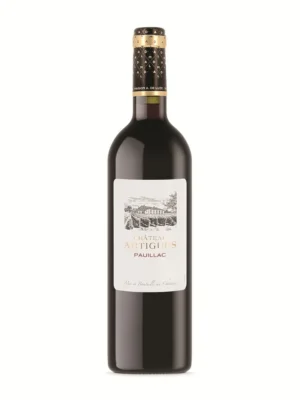
Three large plots in the best parts of Pauillac form the vineyard of this classified growth, an unusual configuration and a direct inheritance from the estate’s founder, Pierre Ducasse, an eminent lawyer. In the 18th century he gave a single name to a fine vineyard holding, which was put together through inheritance and purchases. When he died in 1797, his son, Pierre, inherited a 60-hectare exploitation, named Ducasse-Grand-Puy-Artigues-Arnaud, of which two third were planted with vines. The estate was classified in 1855, under the name of Artigues Arnaud.
Thanks to impeccable harvesting and tailor-made winemaking, Cabernet Sauvignon and Merlot produced a wine renowned for its aromatic complexity, glorious structure and ageing capacity, all true to the classic Pauillac style.
For more info, visit Château Grand-Puy Ducassewebsite.
The Château Haut-Veyrac property, owned by the Castaing family, is located on one of the hills overlooking the village of Saint-Émilion in Saint-Étienne de Lisse. The vineyard now extends over an exceptional terroir of 9 hectares in one piece. The clay-limestone soil makes it possible to cultivate the Merlot Noir and Cabernet Franc grape varieties in the best conditions.
Situated in the commune of Martillac, this 20-hectares property once belonged to Baron de Montesquieu. Today, the estate is owned by Mr. Eric Perrin which also owns the famous Château Carbonnieux. Because of its special localization, its terroir and the choices of winemaking in the vineyard and the cellar, the Château Haut-Vigneau plays between the greatest ones.
This Haut-Vigneau blanc is quite characteristic of the terroir and the appellation of the AOC Pessac-Léognan.
After the 2000 vintage, Juliette Bécot and her father Gérard Bécot wanted to join forces to acquire a new family property. A new challenge for Gérard, and for his daughter Juliette, who is taking her first steps in this magical and exciting profession.
It was while searching in the neighboring Appellations of Saint-Emilion, a property offering great potential due to the quality of its wines and its terroirs, that they discovered Château Joanin in Saint-Philippe-d’Aiguille. With the desire to personalize this vineyard, they wanted to add their family name to it. Thus, they brought this vintage to life, giving it a first and last name: “Joanin Bécot”.
The main desire, through each vintage, is to preserve all the flavors and charm of the fruit, while relying on the notion of terroirs, truly attractive and promising in the “Castillon Côtes de Bordeaux” appellation.